03.2 §1The Volume Story
CIPA — the Camera & Imaging Products Association — publishes monthly shipment data covering interchangeable-lens cameras, compact cameras and lenses. The interchangeable-lens series is the one that matters most to understanding where the industry has moved.
In 2016, interchangeable-lens camera shipments sat at roughly 11.7 million units globally, already well below the category peak of around 20 million units in 2012. The decline that followed was not a cliff — it was a sustained gradient. By 2022, annual shipments had fallen to roughly 6 million units, and 2023 settled at about the same level, less than a third of the 2012 figure and roughly half of 2016's already-contracted baseline.

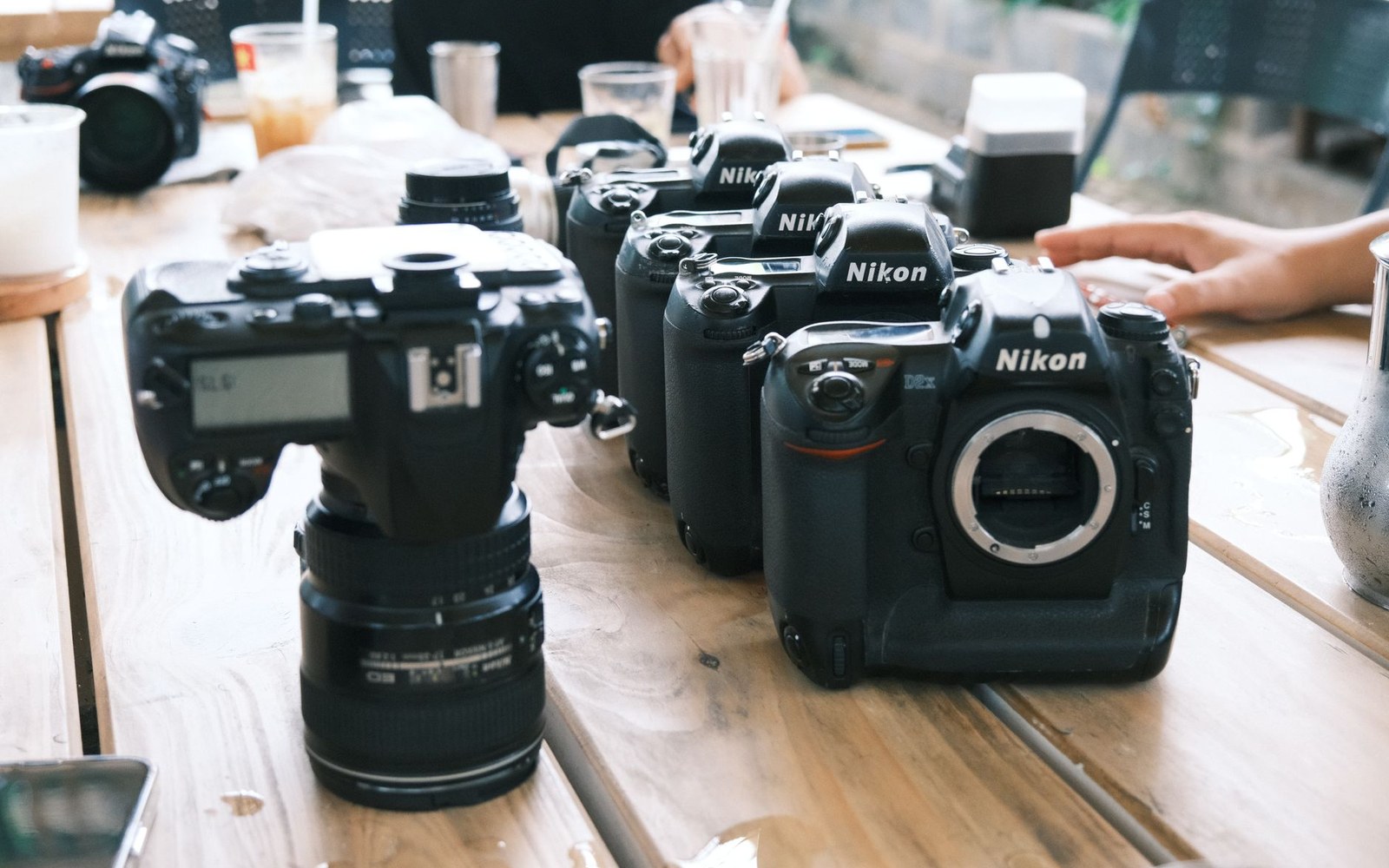
The causes were structural, not cyclical. Smartphones had already absorbed the casual photographer. The DSLR upgrade cycle that had sustained volumes through the 2000s and early 2010s was exhausted. Remaining buyers were experienced shooters replacing ageing bodies, not new entrants expanding the market.
03.2 §2The Price Story
Against that compression in volume, average selling prices moved in the opposite direction. CIPA's own unit-value data, derived from shipment value divided by unit count, shows that the average interchangeable-lens camera sold for the equivalent of roughly ¥70,000–80,000 in the mid-2010s. By the early 2020s that figure had climbed toward ¥120,000–150,000 and continued rising.
In 2016, interchangeable-lens camera shipments sat at roughly 11.7 million units globally, already well below the category peak of around 20 million units in 2012.
Several forces drove this. Canon, Nikon and Sony each vacated the entry-level DSLR and mirrorless segments as volumes there collapsed, concentrating their launches on higher-specification bodies — the EOS R5, the Z8, the Alpha 1 — with correspondingly higher prices. Mirrorless architecture itself added cost initially: new mount tooling, new lens lines, electronic viewfinders with higher-resolution panels, and more sophisticated in-body stabilisation systems all carried engineering expenditure that was amortised across fewer units. Ricoh's own K-3 Mark III, announced in 2021, is illustrative: an APS-C body with a five-axis IBIS mechanism, 25.7 MP sensor and 12 fps mechanical drive, priced at launch above the K-3 II it replaced by a meaningful margin.
The currency effect compounded everything. The yen's sustained weakness against the dollar and euro from 2022 onward pushed yen-denominated prices upward for Japanese manufacturers while also increasing the translated retail price in Western markets, even before any additional specification uplift justified a premium.
03.2 §3What the Inverse Relationship Means
A market that ships fewer units at higher prices per unit is not simply a smaller market — it is a structurally different one. Total revenue to manufacturers has not collapsed in proportion to unit count because the per-transaction value has risen to partially offset volume losses. This is the core of what the CIPA data shows when value series and volume series are read together rather than in isolation.
For a company like Ricoh, which holds a very small share of global interchangeable-lens shipments, the dynamic cuts both ways. The higher-price environment validates continuing to produce low-volume, high-specification bodies — the K-3 III Monochrome launched in 2023 sits at a price point that would have seemed anomalous for an APS-C body a decade ago. But the same environment demands that each new body justify its cost entirely on specification and durability, because the buyer who remains in the market after this contraction is not making an impulse purchase.
The CIPA figures do not tell a story of an industry in terminal decline so much as one undergoing a selection event — low-margin commodity bodies have been eliminated, and what survives is concentrated at the higher end of the specification and price range. Whether that equilibrium is stable, or whether volume continues to erode faster than price can compensate, is the question the data from 2024 and beyond will begin to answer.
Where this comes from
- CIPA · www.cipa.jp