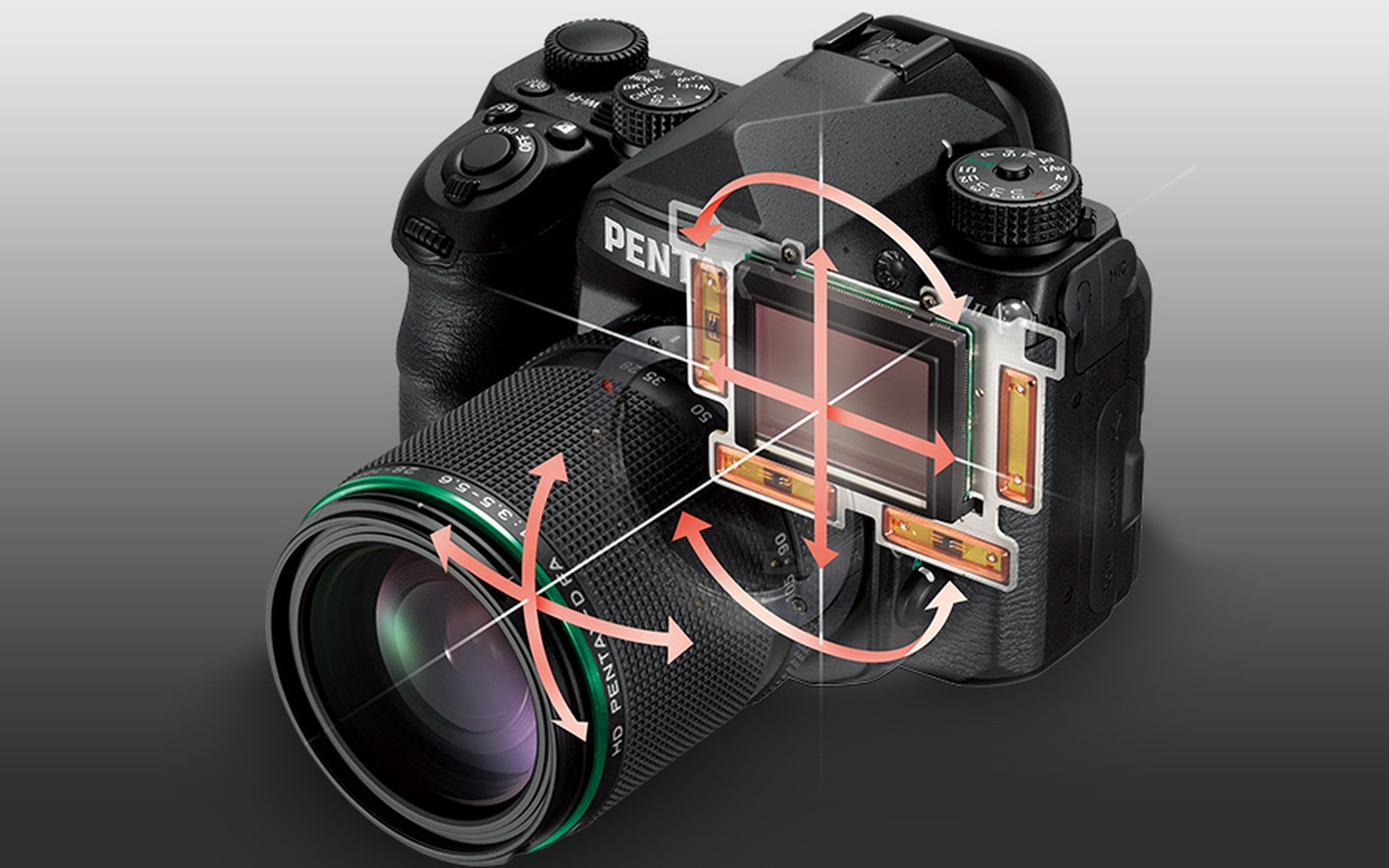
One set of actuators, two entirely different correction algorithms — and only one of them needs to know where on Earth you are.
04.4 §1The Same Hardware, Running Different Software
Pentax SR — Shake Reduction — operates by moving the sensor on a five-axis plane to counter the angular velocity detected by gyroscopic sensors inside the body. The correction is reactive: the gyros report movement, the actuators push back. The reference frame is the camera itself. Nothing outside the body is consulted.
Astrotracer works from the opposite premise. The sensor must move with a target rather than hold still relative to the body. To do that, the firmware needs to know the camera's precise geographic coordinates and orientation — which requires a GPS fix — and then compute a compensation path that matches Earth's rotation rate of approximately 15 arcseconds per second. The actuators execute that path as a slow, continuous drift rather than a rapid opposition to shake. SR and Astrotracer share every physical component: the same electromagnetic actuators, the same sensor-suspension mechanism, the same drive electronics. What differs is the instruction the firmware sends.
The two modes are therefore mutually exclusive. Astrotracer disables conventional SR for the duration of an exposure, because the correction vectors point in opposite directions. SR attempts to return the sensor to a fixed position; Astrotracer attempts to move it away from one. Running both simultaneously would produce noise rather than correction.

This also explains why Astrotracer accuracy degrades at wide declinations and very long exposures. The sensor travel range — the same physical limit that governs how much SR compensation the system can apply — sets a ceiling on how far the sensor can drift before it hits its mechanical boundary. CIPA's standardised test for IBIS measures compensation in EV stops, a figure that maps directly to the displacement range available. For Astrotracer, that same displacement range translates to a maximum trackable duration before stars begin to trail again.
One set of actuators, then — doing contradictory things depending on which algorithm is running.
Where this comes from
- CIPA's standardised test for IBIS · www.cipa.dc.or.jp