02.1 §1The Mirror Was a Constraint, and Its Removal Was Not Coordinated
A single-lens reflex camera requires a mirror box between the lens and the sensor. That box occupies space, and the space has a precise depth: the flange-to-film distance. For Canon's EF mount, introduced in 1987, that figure is 44 mm. For Nikon's F-mount, dating to 1959, it is 46.5 mm. Those numbers were not arbitrary — they were the minimum that could reliably house a swinging mirror without clipping the rear element of a lens. Remove the mirror, and the constraint disappears. Each manufacturer was therefore free to set any flange distance they chose, and each chose differently.
Sony moved first. The E-mount, launched in 2010 with the NEX series, sits at 18 mm flange distance — a figure so short that almost any legacy lens can reach the sensor plane with a passive adapter. The mount diameter is 46.1 mm. Sony designed E-mount initially around APS-C sensors; when full-frame arrived with the A7 series in 2013, the mount diameter was unchanged, which created optical compromises at the extreme corners of the full-frame image circle that Sony's optical engineers subsequently worked around in lens design rather than solved at the mount level.

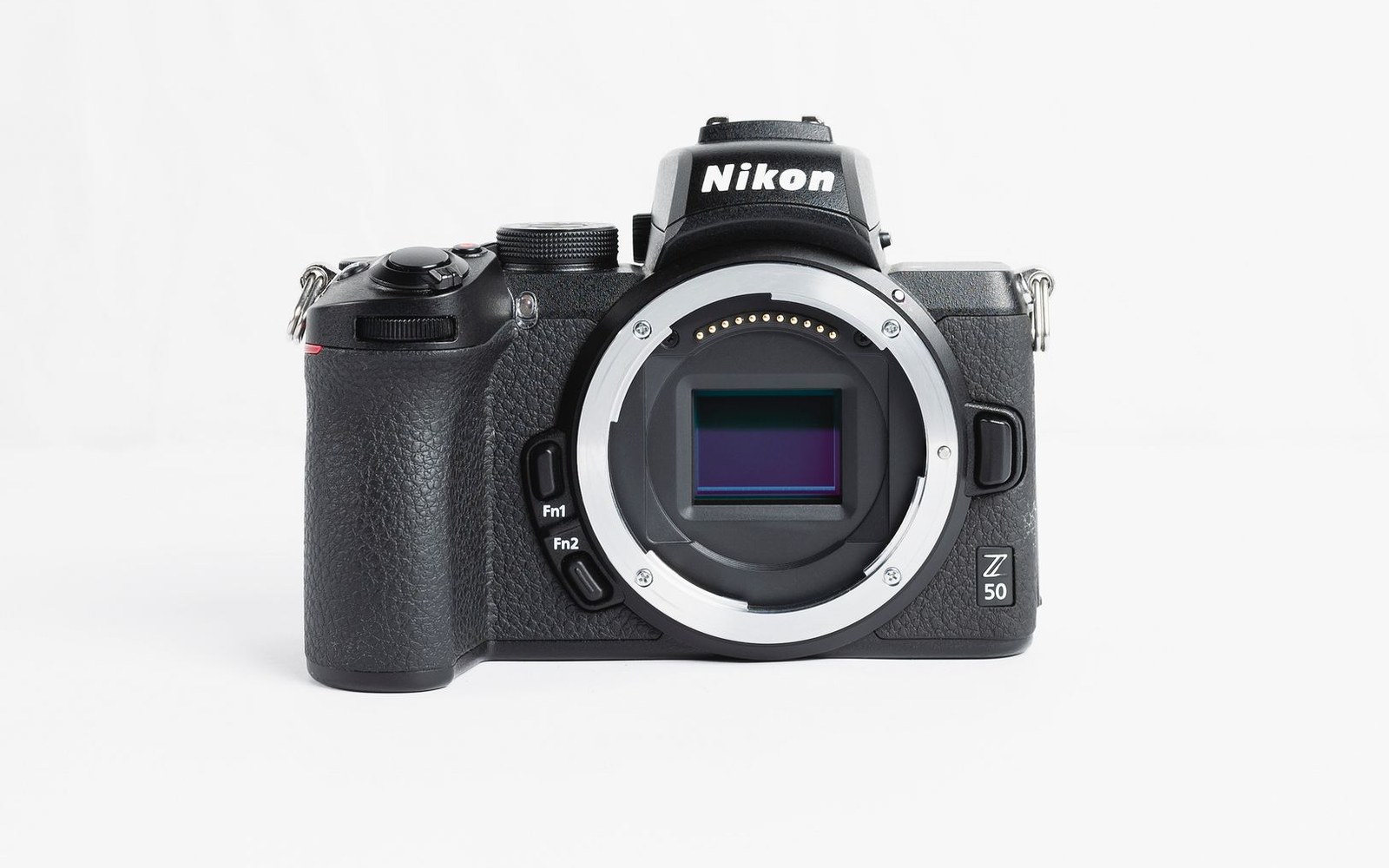
Nikon launched the Z-mount in 2018. Its flange distance is 16 mm — even shorter than Sony's — and its internal diameter is 55 mm, the largest of the four systems under consideration here. Nikon published the rationale directly: the large throat allows rear lens elements to sit very close to the sensor and very wide in diameter, reducing the angle of incidence for marginal rays and easing the optical design of fast, wide lenses. The Nikkor Z 58mm f/0.95 S Noct, a manual-focus lens announced alongside the system, was the demonstrator for what that throat diameter permits.
Canon launched the RF mount, also in 2018, with a 20 mm flange distance and an internal diameter of 54 mm — close to Nikon's, wider than Sony's. Canon's notable engineering choice was the communication protocol: twelve electrical contacts versus Sony's ten and Nikon's eleven, with Canon using a higher-speed data bus to support lens functions including a control ring. Canon has not published the full protocol specification, which has practical consequences for third-party lens manufacturers.
The L-Mount Alliance — Panasonic, Leica and Sigma, announced in September 2018 at Photokina — settled on a 20 mm flange distance and a 51.6 mm internal diameter, figures derived from Leica's SL-mount specification, which Leica had introduced in 2015. The alliance is structurally different from the three proprietary systems: member companies share the mount specification openly between themselves, meaning a Sigma lens mounts on a Panasonic body without an adapter, and vice versa. Whether that constitutes an open standard depends on your definition; the specification is shared among alliance members, not published to the industry at large.
02.1 §2Four Different Answers to the Same Engineering Question
Lay the numbers in a row: Sony E at 18 mm flange, 46.1 mm diameter; Nikon Z at 16 mm, 55 mm; Canon RF at 20 mm, 54 mm; L-Mount at 20 mm, 51.6 mm. No two systems agree on both dimensions, and no two systems share a communication protocol. A lens designed for one mount will not autofocus on any other without an electronic adapter, and in several cases will not physically mount at all.

The fragmentation is not accidental — it is the outcome of competitive industrial logic applied simultaneously by organisations that had no reason to coordinate. Canon and Nikon both announced mirrorless full-frame systems in the same calendar year, each having independently concluded that their legacy SLR mounts were liabilities. Sony had an eight-year head start with E-mount and a growing share of the full-frame interchangeable-lens market. The pressure to respond was real, and the competitive pressure made coordination impossible even if any party had wanted it.
What makes the 2018 moment unusual in industrial history is how compressed it was. Three of the four mounts under discussion were either launched or reorganised within a twelve-month window. CIPA's shipment data contextualises the urgency: interchangeable-lens camera shipments had fallen from a peak of roughly 12 million units in 2012 to a markedly lower level by 2018, according to CIPA's published annual figures. A contracting market in which the major players are simultaneously redesigning their foundational hardware is a market under structural stress.

The K-mount, Pentax's bayonet standard introduced in 1975 with a 45.46 mm flange distance, sits outside this reorganisation entirely. Ricoh, which absorbed Pentax in 2011, has not announced a mirrorless system. The flange distance — identical to the original specification — means that a K-mount body retains mechanical compatibility with lenses dating to 1975, a continuity none of the mirrorless pivots preserved with their own legacy glass.
02.1 §3What Permanent Incompatibility Actually Costs
The cost of fragmentation is distributed unevenly. For a lens manufacturer, the mirrorless transition multiplied the number of mount variants required to address the market. Sigma and Tamron, which produce lenses for multiple systems, now maintain separate optical and mechanical designs for Sony E, Canon RF, Nikon Z and L-Mount — four production lines where two sufficed for the SLR era's Canon EF and Nikon F. Sigma's membership in the L-Mount Alliance provides native access to that ecosystem but does not reduce the engineering burden for the others.
For the photographer, incompatibility means that lens investments made in one system are stranded if the manufacturer discontinues support — a non-trivial concern in a market that has contracted by roughly two-thirds from its peak. Each system's value depends partly on the confidence that the manufacturer will continue populating its lens roadmap, and that third-party manufacturers will continue to reverse-engineer or license the protocols required to autofocus reliably. Canon's unpublished RF communication specification has been a recurring point of friction: third-party lenses appeared late on RF bodies, and reliable autofocus performance lagged proprietary glass by a measurable interval.
Sony's long head start with E-mount produces a different kind of lock-in. The mount's narrower throat relative to Nikon Z places real constraints on certain optical designs, but the sheer volume of native glass — and the established ecosystem of third-party support — makes exit costly for users who have invested heavily. The network effect of a large installed base is itself a competitive barrier, independent of the engineering choices that created it.
The irony that runs through this entire episode is that the industry replaced one source of fragmentation — proprietary SLR mounts that had coexisted uneasily for decades — with four new ones, all designed within roughly eight years, none of them interoperable, and all of them now load-bearing for the manufacturers' futures in a market where the total number of cameras shipped continues to fall.