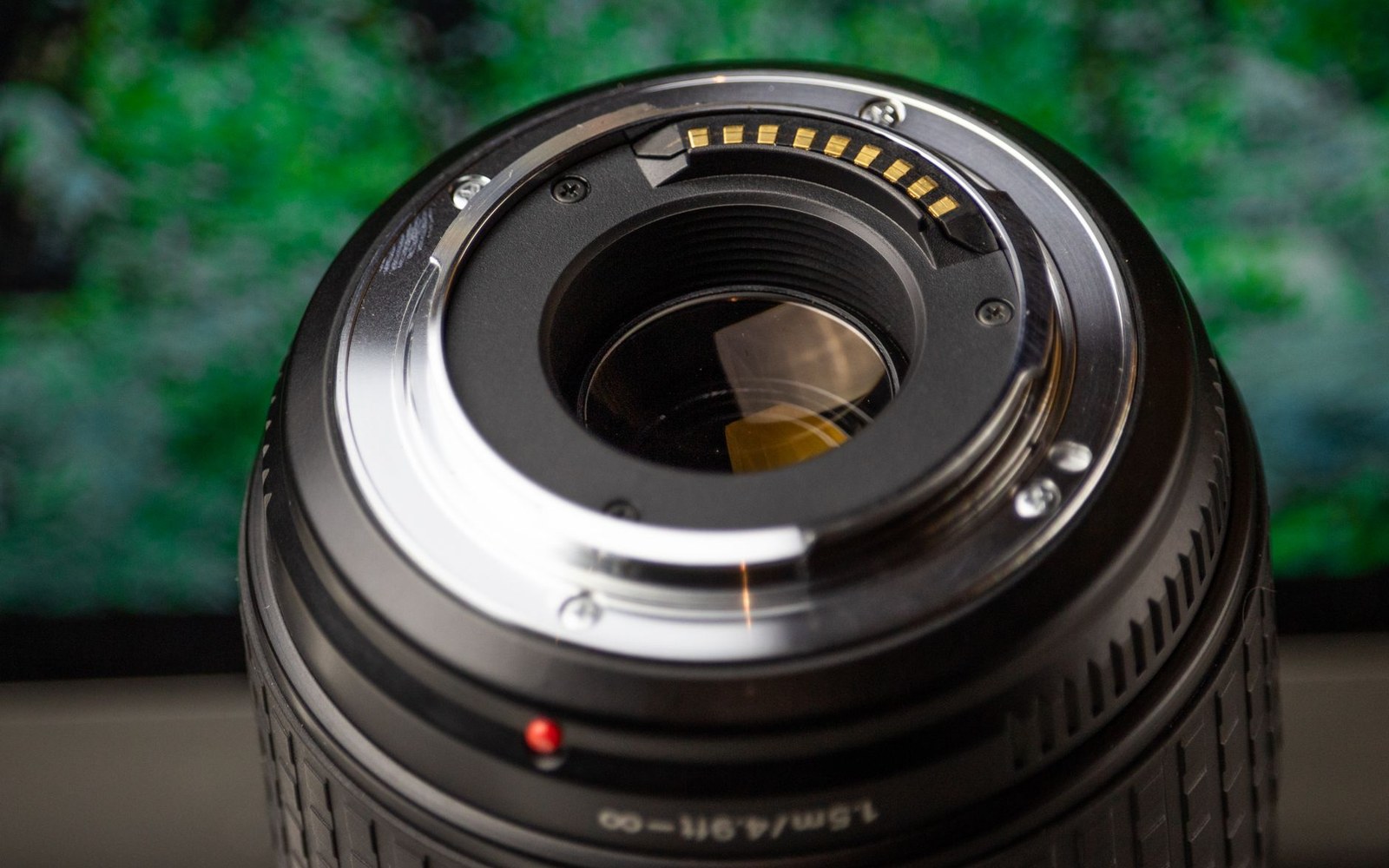
01.6 §1The Dimension That Did Not Move
When Asahi Optical introduced the K-mount in 1975, the engineering team fixed the flange-to-sensor distance at 45.46 mm. That figure — the gap between the mount's reference flange and the film plane, later the sensor plane — has not changed across any Pentax or Ricoh body produced in the intervening five decades. A Super-Takumar adapted to K-mount aside, every K-mount lens made between 1975 and today will physically couple and communicate with the K-3 Mark III body Ricoh shipped in 2021.
The decision was not accidental generosity. A longer flange distance makes the camera body deeper, increases the minimum lens-to-sensor working length, and constrains the optical formulae available to lens designers. But it also creates a mechanical ledger that accumulates value with each passing year: every lens released into the ecosystem is a permanent deposit. Discontinuing one body and shipping another does not retire the glass.

01.6 §2What Holding the Number Costs — and Pays
Forty-five point four-six millimetres is longer than the flange distance of any of the major mirrorless mounts. Canon's RF mount, introduced with the EOS R in 2018, sits at 20 mm. Nikon's Z mount is 16 mm. Sony's E-mount is 18 mm. The shorter the distance, the closer the rear element can sit to the sensor, which is a primary enabling condition for wide-angle lenses with high centre-to-edge sharpness at large apertures. On that metric, K-mount is at a structural disadvantage in the mirrorless era.
The engineering trade runs in both directions, however. Because 45.46 mm is shorter than the flange distance of some other SLR systems, K-mount bodies can accept lenses from those systems through simple mechanical rings. A Nikon F lens, designed for 46.5 mm, clears the distance; a Canon FD lens, designed for 42 mm, does not. Adapters work only when a lens's native flange distance is at least as long as the body's: the ring fills the difference, and the lens still reaches focus at infinity. The reverse is not possible without corrective optics; no adapter can remove flange distance the body already has.
A longer flange distance makes the camera body deeper, increases the minimum lens-to-sensor working length, and constrains the optical formulae available to lens designers.
Ricoh has used this legacy directly. The K-3 Mark III, the KF, the K-70 — each ships as a contemporary APS-C body that also functions as an archive reader for five decades of K-mount glass and an adapter platform for foreign optics going back to the M42 screw era. That is a product value proposition built on native mechanical compatibility across five decades of the mount.
01.6 §3The Sensor Underneath
The sensor changes; the distance does not. Ricoh sources its APS-C sensors from Sony Semiconductor, as does a significant portion of the industry. The 25.7 MP BSI CMOS in the K-3 Mark III sits at the same nominal plane distance as the film gate in a 1975 Pentax K2. Mechanically, the mount is the constant; the detector behind it is updated on a different schedule entirely.

This architectural separation matters to the K-mount's commercial logic. CIPA data shows interchangeable-lens camera shipments contracting sharply from the 2012 peak of roughly 12 million units annually to a fraction of that peak in recent years. In that environment, Ricoh is not competing on volume. The K-mount's 45.46 mm dimension is, among other things, a moat: any shooter who has accumulated K-mount glass faces a switching cost that Canon, Nikon or Sony cannot easily dissolve. The lenses already purchased keep the body relevant.
The consequence of a fixed flange distance is, ultimately, a fixed community. Pentax users do not retire their glass when they upgrade a body. Ricoh does not need to ship a new lens ecosystem each generation. The HD Pentax-DA and D FA lenses produced under Ricoh ownership join a catalogue that physically reaches back to the Ford administration. No other active camera system can claim the same unbroken mechanical continuity.
Forty-five point four-six millimetres is, by one reading, a technical constraint from an era before mirrorless optics were conceivable. By another, it is the entire basis of Ricoh's argument for staying in the market.
Where this comes from
- CIPA data · www.cipa.jp