
01.2 §1What the Bayer Array Was Doing
A standard colour sensor does not record colour directly. It records intensity through a mosaic of red, green and blue filters — the Bayer array, patented by Bryce Bayer at Kodak in 1976 — laid over the pixel grid in a repeating 2×2 pattern of two green, one red and one blue cell. Full-colour values at each pixel location are then interpolated from neighbours, a process called demosaicing. The filters are not free: each one blocks the wavelengths it is not sampling, so any given photosite collects only a fraction of the light actually arriving at its surface.
On the K-3 III's 25.7-megapixel APS-C sensor — sourced, as with most APS-C bodies in the industry, from Sony Semiconductor — the green-filtered photosites capture roughly half the incoming photons, the red and blue sites substantially fewer. The Bayer mosaic is the compromise that makes colour possible on a single sensor layer; it is not the sensor itself.

01.2 §2The Subtraction
Ricoh's engineering decision on the K-3 III Monochrome was to omit that filter mosaic entirely. Each of the 25.7 million photosites then receives the full spectrum of incoming light — no colour channel, no filtering loss, no demosaicing step. The sensor measures luminance across its full area rather than luminance sampled through a colour grating.
The consequence published in Ricoh's own specification is a maximum ISO of 1,600,000 — a figure reached with no colour filter array in the light path. Sensitivity climbs because each photosite is no longer obliged to discard the wavelengths its filter would have rejected. More photons reach the silicon; the sensor generates a stronger signal relative to its noise floor at any given exposure level.
The Bayer mosaic is the compromise that makes colour possible on a single sensor layer; it is not the sensor itself.
Resolving power changes in a related but structurally separate way. On a colour sensor, the effective spatial resolution is limited by the Bayer grid: any fine detail smaller than the mosaic's repeat unit is reconstructed through interpolation, not directly sampled. Remove the mosaic and every pixel records an independent luminance value. Ricoh's published materials describe the result as 1.7 times the resolution of the standard body — a figure that reflects the elimination of demosaicing blur rather than any change to pixel count, which remains identical at 25.7 megapixels. The sensor is the same piece of silicon; what changed is what sits on top of it.
The anti-aliasing filter is also omitted from the Monochrome. Without colour interpolation, the artefacts the AA filter was designed to suppress — moiré patterns arising from colour aliasing — do not occur in the same way. Luminance aliasing remains theoretically possible, but Ricoh's engineers accepted that risk in exchange for preserving the full optical resolution the lens can deliver to the sensor.
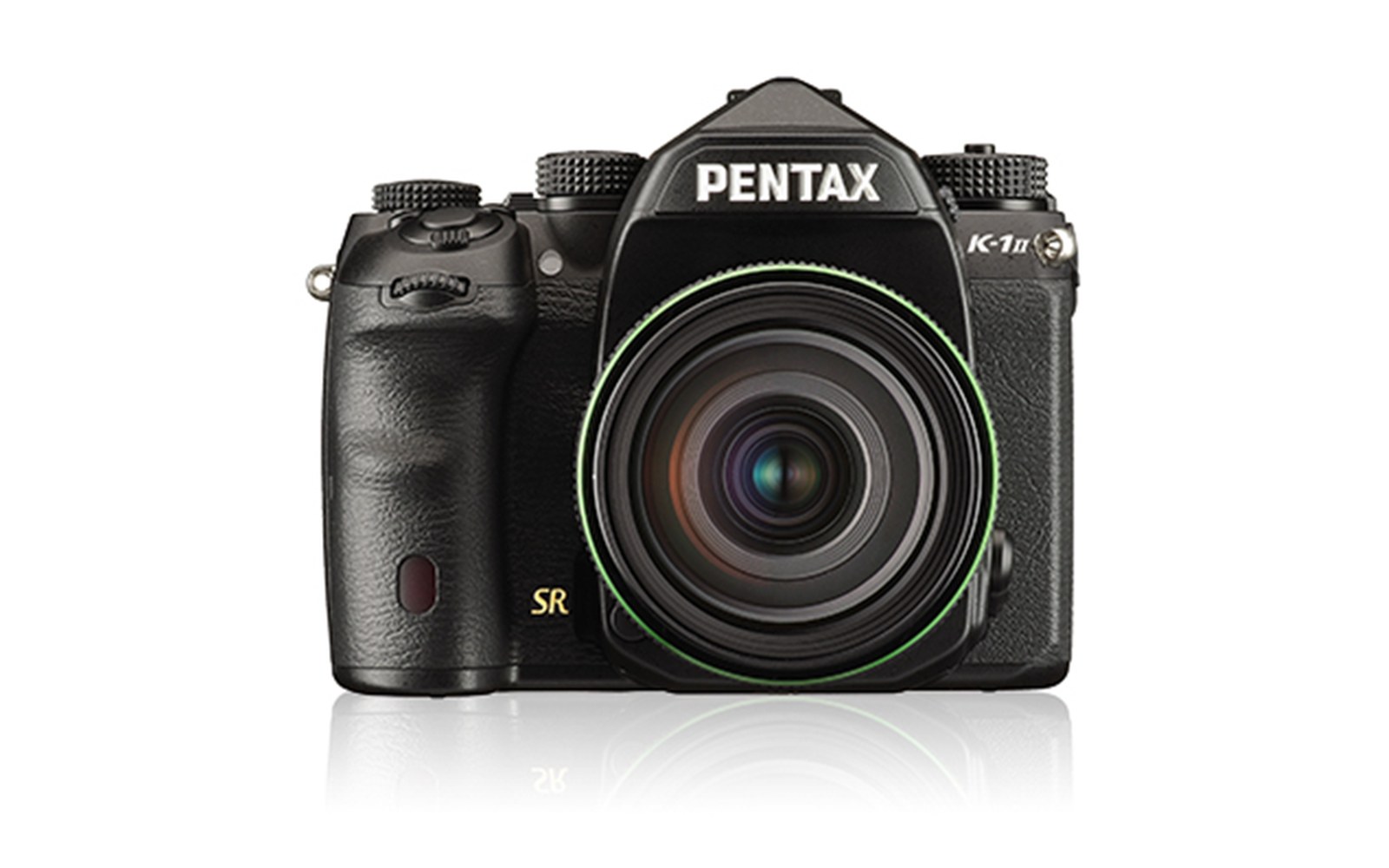
01.2 §3What Tonal Range Means Without Colour
The Monochrome body captures 14-bit raw files in Ricoh's PEF format or Adobe's DNG. Fourteen-bit depth yields 16,384 discrete tonal steps per channel — here meaning per luminance level, with no channel separation to manage. The practical implication is a rendering of gradients in skin, fabric, stone and sky that no colour body can match through software conversion, because a software conversion begins with the tonal data the Bayer-filtered sensor actually captured: a partial, interpolated luminance record rather than a direct one.
The body is otherwise mechanically identical to the K-3 Mark III: same magnesium-alloy chassis, same 5.5-stop IBIS, same 101-point phase-detect AF system, same 92 weather-resistance seals, same K-mount with its 45.46 mm flange distance maintained since 1975. The subtraction is entirely at the sensor surface. Everything the camera does to hold the lens steady, find focus and survive weather is unchanged. Only the filter that enforced colour on the light is gone.
Where this comes from
- Bayer array · en.wikipedia.org
- Ricoh's own specification · www.ricoh-imaging.co.jp